Epson SureColor F3070 Industrial DTG Printer
Overview
Production Garment Printing at Industrial Speed
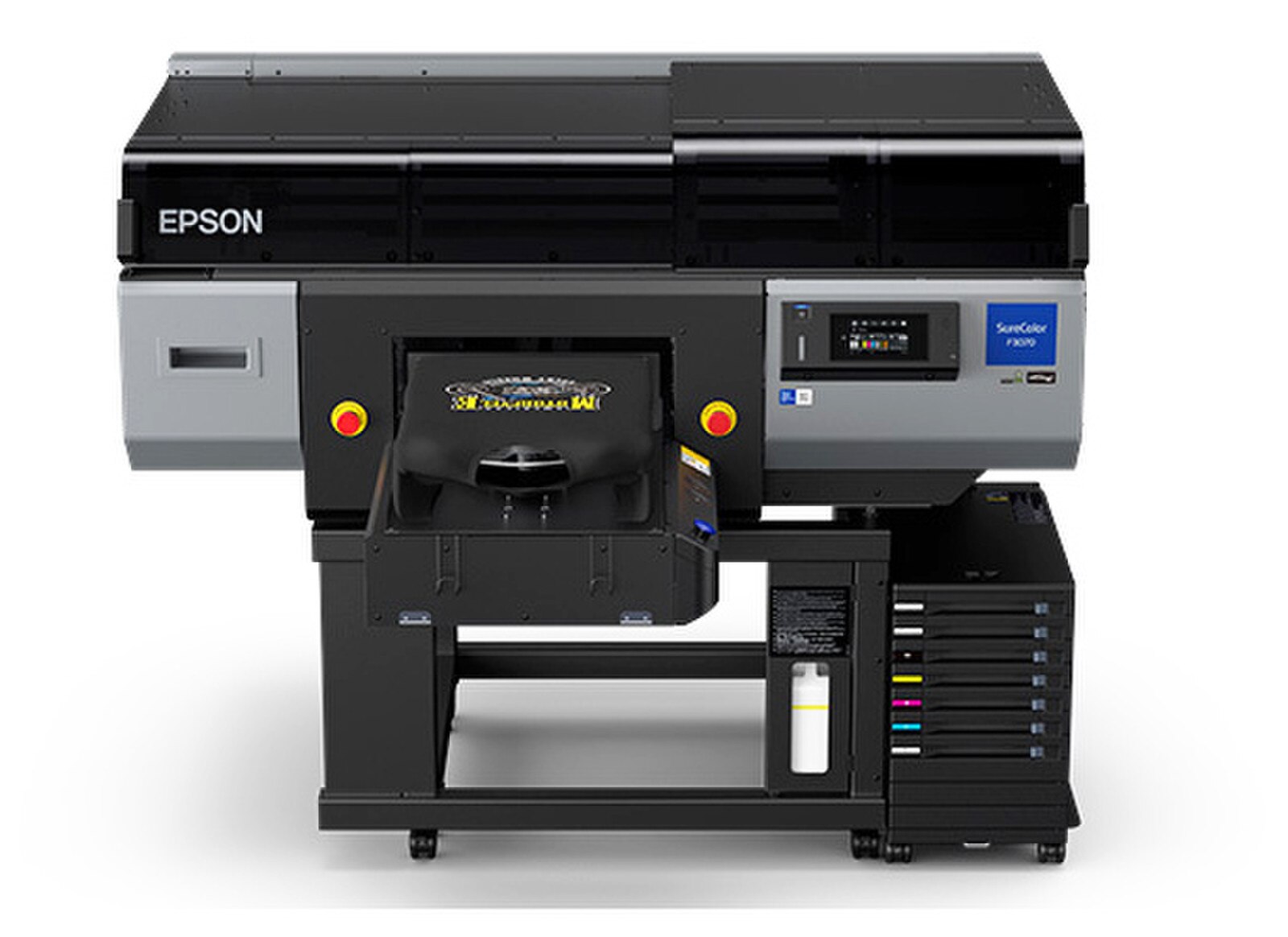
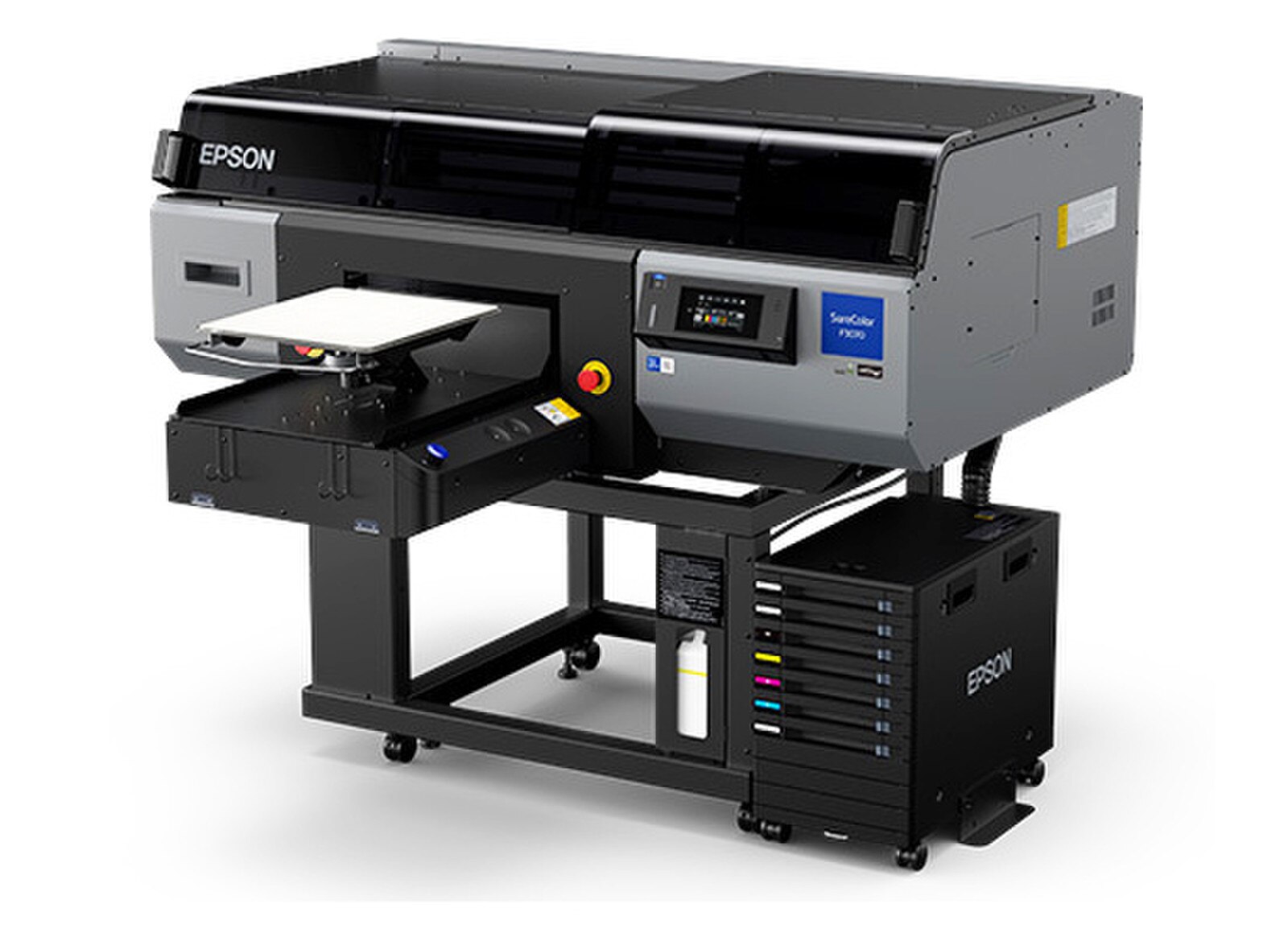
The SureColor F3070 is built for shops printing hundreds of shirts a day, not dozens. Dual PrecisionCore printheads carrying 16,000 nozzles lay down one-pass prints at industrial speeds, while a bulk ink system and automatic garment thickness detection remove the two things that slow most direct-to-garment operations: frequent cartridge changes and manual platen adjustment. It is the first Epson DTG printer to integrate bulk ink, and the result is a materially lower cost per garment than cartridge-fed machines.
Key Features
- Dual PrecisionCore microTFP printheads — 8,000 white and 6,400 color nozzles for one-pass output at production speed
- Bulk ink packs at 1,500 mL — the first bulk system in an Epson DTG printer, reducing refill frequency and cost per print
- Automatic garment thickness detection — adjusts printhead height without operator intervention, up to 29.5 mm media thickness
- UltraChrome DG ink — CMYK plus white, priced the same per unit for color and white
- Quick-load platen — cuts loading time against traditional hoop platens
- Dedicated cleaning channels and fabric head wiper — reduces maintenance downtime
- 1200 × 1200 dpi with variable droplet technology
- Garment Creator 2 software — macOS and Windows, with cost estimator, hot folders, and an automation SDK
- Standard 120 V operation on a compact casters-mounted stand, so units can be added as volume grows
- Oeko-Tex ECOPASSPORT certified and RoHS compliant
Where the Running Cost Actually Goes
White ink is the variable that decides DTG economics. On dark garments it forms the underbase beneath every color, so a shop printing dark shirts consumes far more white than color — and on most platforms white costs more per millilitre. The F3070 prices white and color identically and supplies both in 1,500 mL packs, which changes the arithmetic on exactly the work that is hardest to quote. Pair that with dedicated cleaning solution channels and the fabric head wiper, and the machine spends more of the day printing rather than being maintained.
Why DTG Rather Than a Transfer
Direct-to-garment prints ink into the fabric itself, so there is no transfer film sitting on the surface and no hand feel where the image lands. On cotton that produces detail and softness no transfer method matches, which is why DTG holds the retail and boutique end of the apparel market. The tradeoffs are real: dark garments require pretreatment, and the technology is at its best on cotton and high-cotton blends. Shops working across polyester, bags, caps, and hard goods commonly run DTF alongside DTG rather than choosing between them.
Applications
Contract decorating and print-on-demand fulfillment, retail and boutique apparel lines, team and corporate wear, licensed merchandise, and sampling for larger runs. Any operation where cotton is the substrate, order sizes vary, and screen setup cannot be justified.
Why Choose the F3070?
It is the machine for the point where DTG stops being a side service and becomes the production line. Shops outgrowing cartridge-fed equipment usually hit three walls at once — ink cost on dark garments, downtime for maintenance, and the operator time lost to platen adjustment between garment types. The F3070 was engineered against all three, and its compact 120 V footprint means the second and third units drop into the same room without an electrical project.
Specifications
| Printing technology | Dual PrecisionCore microTFP 10-channel drop-on-demand inkjet printheads with ink-repelling coating |
|---|---|
| Nozzle configuration | 8,000 white; 6,400 color |
| Maximum resolution | 1200 × 1200 dpi |
| Droplet size | Variable Droplet Technology |
| Ink type | Epson UltraChrome DG |
| Ink configuration | 5-color: cyan, magenta, yellow, black, white |
| Ink pack volume | 1,500 mL per pack; 2-year shelf life from production date |
| Garment thickness | Up to 29.5 mm |
| Interfaces | Hi-Speed USB 3.0 (1); 1000Base-T Ethernet (1) |
| Printer language | Epson ESC/P raster |
| Operating systems | Windows 10 and 8.1; macOS 10.12 or later |
| Power | AC 100–120 V / 200–240 V, 50/60 Hz; 8.2 A at 100–120 V; requires two outlets |
| Power consumption | Printing approx. 168 W; sleep approx. 20 W |
| Operating environment | 59° to 95°F (15° to 35°C); 20–80% humidity, no condensation |
| Certifications | Oeko-Tex ECOPASSPORT; RoHS compliant |